
Our story
From individual tests to a universal diagnostics platform
HueDx was built around a simple observation that much of the diagnostics industry has learned to accept rather than solve: diagnostic science has advanced, but diagnostic infrastructure has not.
For decades, lab-quality diagnostics have depended on expensive, proprietary readers, centralized laboratories, and rigid workflows. As a result, even when assays are sensitive, validated, and clinically meaningful, they often remain inaccessible at the point of care or in the home. The limitation isn’t chemistry. It’s deployment.
HueDx was created to remove that bottleneck.
Turning optical signals into infrastructure-free diagnostics
The company began in 2018 by developing individual diagnostics end to end across multiple modalities, including colorimetric chemistry, lateral flow assays, and isothermal amplification. Across these efforts, the same constraint surfaced repeatedly: quantitative performance was achievable, but only within tightly controlled environments using specialized hardware.
Even when assays were optimized and analytically sound, they broke down outside the lab.
Rather than building another proprietary reader, HueDx took a different approach.
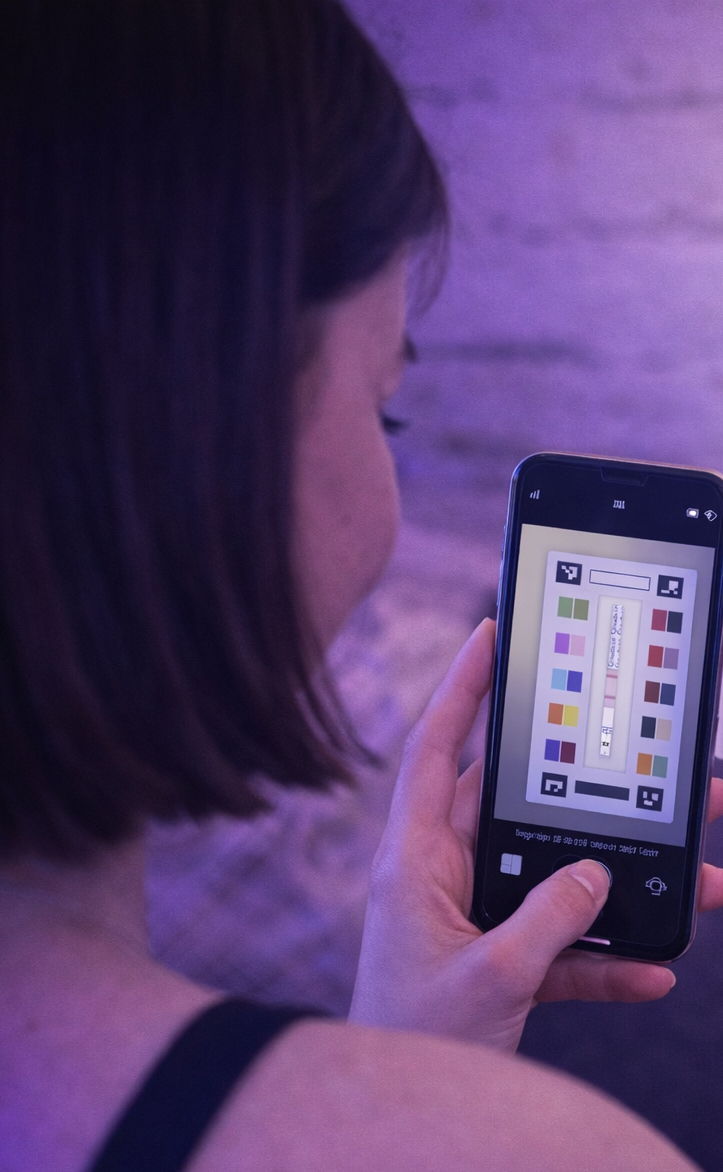
In 2022, we began building a platform that treats the smartphone as the reader and AI as the standardizing layer.
By combining a patented physical reference system (HueCard) with AI-driven image analysis and calibration software (HueTools), HueDx enables accurate, quantitative interpretation of optical signals using an ordinary phone camera—without proprietary hardware. The platform corrects for lighting variation, device differences, and user technique, digitally recovering performance that would otherwise require lab instruments.
The result is a reusable, assay-agnostic foundation for quantitative diagnostics.
A platform designed to scale across assays, markets, and use cases
Launched as a unified platform in 2024, HueDx now operates as a full-stack diagnostics infrastructure, supporting partners and internal programs across medical, veterinary, agricultural, and consumer health applications.
HueTools provides the software layer for assay development, calibration, validation, and quantitative analysis.
HueLab operationalizes validated assays, offering a turnkey path to manufacturing and launch for reader-free, near-patient and direct-to-consumer diagnostics.
HueCard serves as the universal physical interface, enabling consistent optical reference across tests.
Together, these components allow diagnostic teams to bring new tests to market faster, at lower cost, and without rebuilding infrastructure for each assay.
Proof through deployment
HueDx uses its own platform to launch products where gaps in care exist and where quantitative insight matters.
Our first direct-to-consumer product, a fully quantitative ovulation test, delivers daily hormone measurements rather than single threshold-based results. It demonstrates the platform’s ability to translate lab-grade analytics into real-world, frequent-use settings—without sacrificing rigor.
This product is not the end goal. It is proof of capability.
The vision
HueDx is building the infrastructure layer for the next generation of diagnostics—one where assays are no longer constrained by readers, labs, or geography.
By decoupling diagnostic performance from hardware and embedding intelligence in software, HueDx enables a future where:
New biomarkers can be deployed rapidly
Quantitative testing is accessible outside the lab
Diagnostics scale like software, not instruments
That is the platform we’re building—and why HueDx exists.