
HueTools: Quantitative Colorimetric Assay Development Without Specialized Hardware
HueTools: Quantitative Colorimetric Assay Development Without Specialized Hardware
Our peer-reviewed work in SLAS Technology introduces a modular, smartphone-based image analysis platform that replaces subjective visual interpretation with reproducible, machine learning-driven quantification — from first prototype to production-ready diagnostic.
The problem with "good enough" color reads
Colorimetric paper tests are among the most widely deployed diagnostics on the planet. They are cheap, portable, and require no power source. Yet the bottleneck in moving from a promising strip chemistry to a validated quantitative assay has remained stubbornly analog: a researcher holding a strip up to the light, deciding whether the line is "dark enough."
Human color perception is neither precise nor reproducible. Two scientists examining the same lateral flow strip under different room lighting will assign different semi-quantitative scores. Scale this across development batches, multiple devices, and varied environments, and the measurement noise alone can obscure real dose-response signal — costing weeks of iteration and leading teams to abandon assay formats that were, in fact, viable.
Traditional remedies require dedicated colorimeters, laboratory spectrophotometers, or device-locked commercial readers — instruments that are expensive, non-portable, and inaccessible to the resource-limited settings where paper diagnostics matter most. Software alternatives like ImageJ offer flexibility but force researchers to manually stitch together image processing, data analysis, and record-keeping steps, introducing fragmentation and error at every handoff.
HueTools was built to close this gap.
What HueTools does
HueTools is an integrated image processing and machine learning platform for quantitative development of paper-based colorimetric assays using standard smartphone cameras. It combines a mobile capture application, a web-based analysis platform, and a cloud backend into a single end-to-end workflow.
Image acquisition and color correction. The HueDx mobile app standardizes capture conditions and interfaces directly with the HueCard — a printable 48-patch color reference sticker that enables device-independent color calibration. The correction pipeline (white balancing → multivariate Gaussian distribution color transfer → histogram-based dynamic non-linear interpolation → final refinement) reduces average inter-illumination color error from ΔE₀₀ = 7.9 to ΔE₀₀ = 2.07, a 74% reduction, approaching the physical consistency limit of the printed sticker itself. In prior work, applying color correction raised predictive R² from 0.94 to 0.99 and cut mean reproducibility %CV from 31.1% to 13.4%.
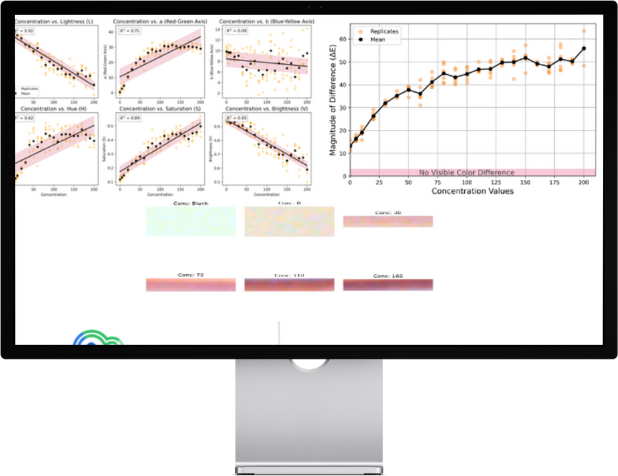
Perceptually grounded signal analysis. Rather than operating in RGB — a device-dependent, perceptually non-uniform space — HueTools extracts features in CIELAB and HSV. The CIELAB L*, a*, b* axes independently encode lightness, red-green chromaticity, and blue-yellow chromaticity. The CIEDE2000 metric (ΔE₀₀) quantifies perceptual color difference relative to a blank reference in a way that directly reflects visual discrimination thresholds. The platform computes all seven features (L*, a*, b*, H, S, V, ΔE₀₀) per region of interest and generates ΔE₀₀-vs.-concentration plots alongside channel-wise dose–response curves with R² linearity metrics.
Ensemble-based predictive modeling. The Stratified Bootstrap Evaluation Framework fits a Random Forest regressor across 100 independent bootstrap train/test rounds, providing concentration predictions, uncertainty estimates, %CV, %TE (RMS and Westgard methods), and CLSI EP17-A2-grounded limits: LoB, LoD, and LoQ. Critically, the framework is designed for the small-sample regime of early-stage assay development: as few as three replicates per concentration level and five concentration points are sufficient to obtain actionable first-pass analytical metrics.
Key design philosophy: HueTools is not intended to replace formal clinical validation. It is engineered to compress the iteration cycle that precedes it — providing data-backed go/no-go signals at each development stage with minimal sample burden.
Validated across two assay architectures
Lateral flow · Luteinizing hormone (LH)
Uncut lateral flow strips were spiked across nine concentration levels (0–100 mIU/mL) in pooled male urine, imaged using iPhone 11 and 13 under three lighting conditions. HueTools quantified a clear dose-dependent progression in ΔE₀₀, with strong linear trends in L* (R² = 0.98), saturation S (R² = 0.97), and a* (R² = 0.93). The predictive model achieved R² = 0.96 across all bootstrap rounds, with LoB = 5 mIU/mL, LoD = 9 mIU/mL, and LoQ = 17 mIU/mL. Signal saturation at the upper concentration range (80–100 mIU/mL) was automatically detected — a diagnostic that would be invisible under visual assessment alone.
Vertical flow · Alanine transaminase (ALT)
The ALT case study was run across two development stages, explicitly demonstrating HueTools' value as an iterative troubleshooting instrument rather than a final validation tool. In Stage I, early analysis revealed reagent leakage causing high signal variance and premature saturation above 250 U/L. The low R² values across color channels were unambiguous: the issue was fabrication, not assay chemistry. The team replaced the adhesive with a laminating sheet and moved to a commercial serum-matched pseudo-matrix.
Stage II results were substantially improved. Color difference increased monotonically up to 458 U/L with no observable leakage, and CIELAB channels showed strong linear correlations (R² ≥ 0.87 for L*, a*, b*). The quantifiable concentration range approximately doubled relative to Stage I. This iteration — from an inconclusive result to a deployable assay range — was compressed from months to weeks, attributable directly to the structured, objective feedback that HueTools provided at each stage.
Why this matters for assay developers
The comparison with existing approaches is instructive. ImageJ/Fiji requires high operator expertise, outputs only RGB pixel summaries, and has no integrated color correction or analytical performance modeling. Commercial readers provide standardized outputs but are device-locked, opaque, and priced for high-throughput clinical settings. Simple mobile apps provide point estimates from a single capture without uncertainty quantification, linearity assessment, or limit estimation.
HueTools occupies a distinct position: explicit, assay-aware color correction; uncertainty-resolved analysis across replicate datasets; and full analytical metric outputs (%CV, %TE, LoB, LoD, LoQ) — at a cost profile consistent with early-stage R&D and resource-limited deployment. It is hardware-independent by design, cloud-based, and cross-platform.
The platform is equally suited to the bench scientist characterizing a novel chromogenic reaction and to the engineering team evaluating manufacturing consistency across fabrication batches. The same features that support assay development — channel-wise dose–response trends, replicate variance profiles, concentration-resolved error metrics — serve as QC acceptance criteria in production pipelines.
On interpretability: The Random Forest ensemble is paired with permutation-based feature importance, identifying which of the seven color channels drive predictive performance for a given assay chemistry. This is not a black-box model — it is a tool for understanding why a signal works, and how to improve it when it does not.
What comes next
Current limitations are well-defined and directly inform the development roadmap. ROI selection remains a manual step; automated strip and band detection for lateral and vertical flow formats is the immediate priority, enabling production-grade pipeline integration and regulatory-compliant workflows. On the modeling side, future versions will incorporate spatial feature extraction — moving beyond mean color summaries to capture gradient patterns, uneven development zones, and fine-grained morphological cues relevant to complex assay formats. Deep learning-based feature extractors operating on full ROI images will extend quantification capability to assays where simple color statistics are insufficient.
Ultimately, these extensions position HueTools as the analytical backbone of a broader smartphone-enabled diagnostic ecosystem — one that closes the feedback loop between field testing and laboratory development, and between prototype chemistry and regulatory submission.
Try HueTools for your assay development
Available for trial and purchase through HueDx, Inc. — hardware-independent, cloud-based, ready to deploy.
